Why True Ceylon Cinnamon?
Understanding the profound difference between authentic Sri Lankan Cinnamomum verum and commercial Cassia cinnamon.
Not All "Cinnamon" Is Created Equal
In global trade, the term "cinnamon" is frequently applied to two completely distinct botanical species with drastically different chemical profiles, safety parameters, and culinary characteristics.
True Ceylon Cinnamon (Cinnamomum verum, translated as "true cinnamon") is indigenous almost exclusively to the island of Sri Lanka. It has been prized for centuries for its delicate aroma, sweet warm flavor, and therapeutic properties.
Conversely, over 90% of retail spice shelves worldwide are stocked with Cassia (harvested from Cinnamomum cassia / aromaticum grown in China, Indonesia, and Vietnam). While cheaper to harvest mechanically, Cassia naturally contains much higher levels of Coumarin — a compound that food safety authorities closely monitor and restrict due to potential liver effects at high, regular intake.
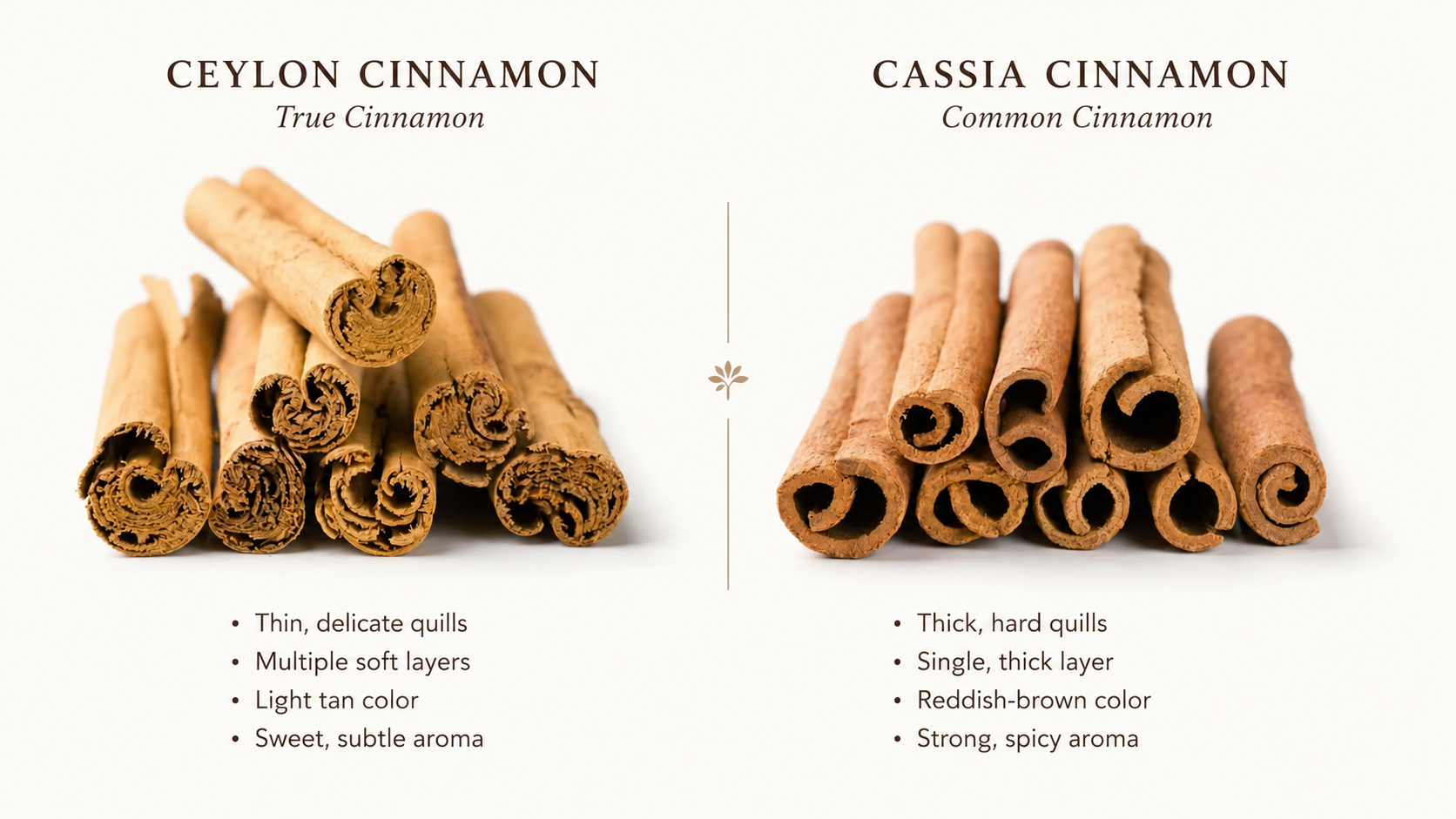
Side-by-Side B2B Specification Comparison
| Feature / Attribute |
Estate Sourced True Ceylon Cinnamon (C. verum) |
Commercial Cassia (C. cassia) |
|---|---|---|
| Botanical Origin | Indigenous to Sri Lanka (formerly Ceylon) | China, Indonesia, Vietnam |
| Coumarin Content |
Trace amounts (~0.004%) Well within recommended daily intake guidelines for regular use. |
High concentration (up to 1.0%) Monitored by the European Food Safety Authority (EFSA) due to potential liver effects at high intake. |
| Quill Physical Structure | Soft, fragile, papery layers of inner bark rolled tightly like a cigar; easily crushed or ground. | Single thick, hard, dark brown bark layer forming a hollow curl; extremely difficult to grind. |
| Color & Appearance | Warm tan, golden-brown hue with subtle uniform surface texture. | Dark reddish-brown to grayish-brown color with rough bark texture. |
| Flavor Profile | Refined, delicate, complex sweet aroma with subtle citrus and herbal nuances. Non-pungent. | Pungent, harsh, bitter, intense spicy heat dominated by heavy eugenol. |
| Harvesting Process | Labor-intensive skilled manual hand-peeling of inner bark layer immediately after harvest. | Mechanical strip harvesting of whole outer and inner bark chunks. |
| Target Industry Applications | Gourmet bakery, high-end confectionery, pharmaceuticals, premium spirits, wellness teas, infant nutrition. | Low-cost mass retail spice shakers, industrial baking where heat masking is tolerable. |
The Coumarin Safety Consideration
Coumarin is a natural benzopyrone compound found at varying levels across cinnamon species. The European Food Safety Authority (EFSA) has established a Tolerable Daily Intake (TDI) of 0.1 mg of coumarin per kg of body weight, reflecting potential effects on liver tissue at higher, sustained intake.
For food manufacturers and distributors, using Cassia in products intended for daily consumption can create regulatory exposure. True Ceylon cinnamon's trace coumarin content keeps it comfortably within recommended intake thresholds, supporting compliance with international food safety guidelines.
Traceability from Sri Lankan Soil
At Uduwara Spices, our Ceylon cinnamon is harvested exclusively from our family-owned estates in Kalutara and Ambalangoda.
Because we source directly from our own estates rather than blending batches from third-party brokers, every quill and bottle of oil can be traced back to a known, single origin — free from Cassia blending or adulteration.